


Day of the Year
Find the day number and remaining days for any date.
The Day Of The Year tool helps you understand how far into the year a selected date is. By choosing a date, the tool calculates the day of the year, the percentage of the year completed, and the number of days remaining, automatically accounting for leap years. The results are presented both numerically and visually with a progress bar, making it useful for planning, tracking milestones, or simply gaining perspective on the calendar year.
Day of the Year
Enter the required values and run the tool to view results.
Recommended Next Checks
Continue the same task with related tools. When possible, your current input is carried to the next page.

Leap Year Calculator
Find out if any year is a leap year.

Find a day
Convert dates to and from common calendar milestones.

Date Calculator
Date Calculator will calculate duration between dates, or add/subtract days.

Gregorian to Lunar Date Calculator
Convert a Gregorian calendar date to the Lunar (Chinese) calendar date.
How to use Day of the Year
Use Day of the Year when you need a fast, browser-friendly way to complete a online task quickly. Enter the required value, review any validation hints, and run the tool to get a clear result that can be copied, downloaded, or used in your next workflow.
This Calendar Tools utility is designed for repeatable checks and everyday troubleshooting. For best results, use complete and accurate input, review the output carefully, and combine the result with related tools when you need a broader diagnosis.
When this tool is useful
- Checking a value before publishing, deploying, or sharing it.
- Saving time on routine calendar tools tasks.
- Comparing results with related IPLocation.net tools for a more complete review.
- Documenting a result for technical support, SEO work, security review, or development notes.
Day of the Year tips
Keep a copy of the original input when comparing results, especially for DNS, web, image, PDF, text, and code tools. If a result depends on live network data, remember that DNS records, HTTP headers, certificates, rankings, and third-party responses can change over time.
Ever wondered what day of the year today is, or what day your birthday lands on each year? A Day of the Year (DOY) tool answers that instantly by converting any calendar date into a simple number from 1 to 365 (or 1 to 366 in a leap year). It’s a small detail that turns out to be weirdly useful for planning, reporting, coding, fitness goals, travel, and even settling arguments like “Is it already basically summer?”
What “Day of the Year” (DOY) Means?
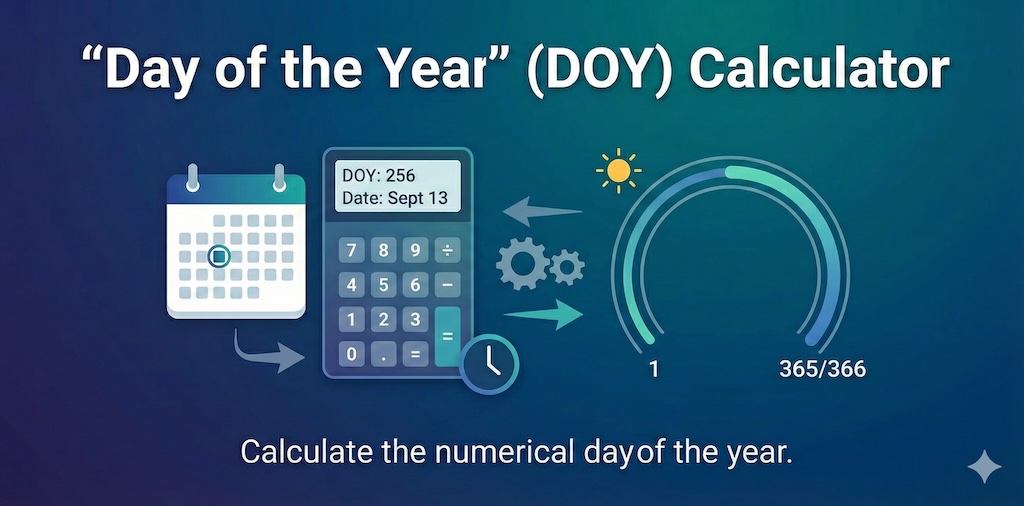
Day of the Year is the count of days since January 1 within a given year. It’s also called the day number or ordinal date. For example, January 1 is DOY 1, January 2 is DOY 2, and so on. By the time you reach December 31, you’re at DOY 365 (or 366 during a leap year).
A DOY tool typically also shows how far the year has progressed, often as a percentage, so you can quickly see how much of the year is complete and how many days remain.
How Many Days Are in a Year?
Most years have 365 days. A leap year has 366 days. That extra day is added to February, turning February 28 into February 29.
Days in Each Month
| Month | Days (Normal Year) | Days (Leap Year) |
|---|---|---|
| January | 31 | 31 |
| February | 28 | 29 |
| March | 31 | 31 |
| April | 30 | 30 |
| May | 31 | 31 |
| June | 30 | 30 |
| July | 31 | 31 |
| August | 31 | 31 |
| September | 30 | 30 |
| October | 31 | 31 |
| November | 30 | 30 |
| December | 31 | 31 |
A quick memory trick: “30 days hath September…” works, but if you want a zero-poetry method, just remember that February is the chaos month and everything else follows the standard 30/31 pattern above.
What Is a Leap Year?
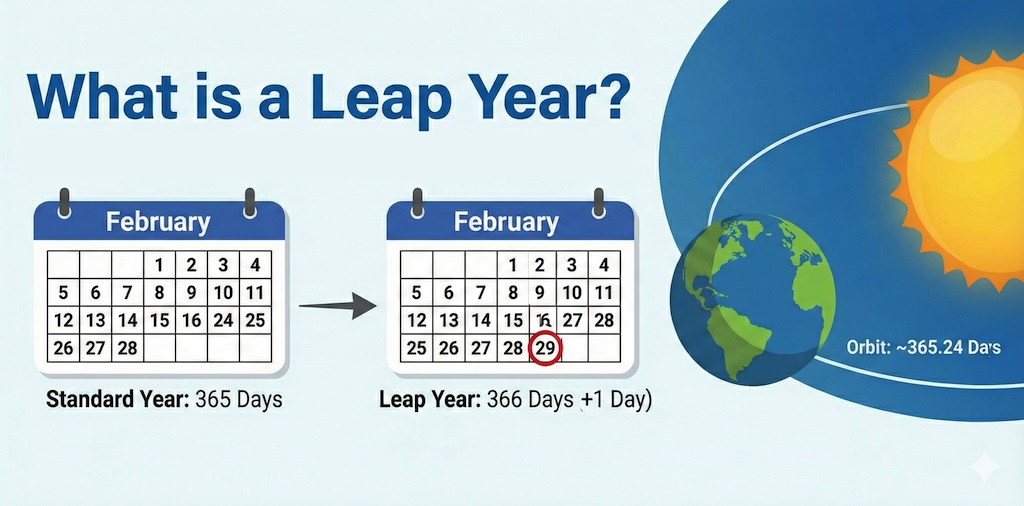
Leap years exist because a solar year isn’t exactly 365 days. It’s approximately 365.2422 days, so we “catch up” by adding a day now and then. The modern rule used by the Gregorian calendar is:
- A year is a leap year if it’s divisible by 4…
- …except years divisible by 100 are not leap years…
- …unless they’re also divisible by 400, in which case they are leap years.
Examples: 2024 is divisible by 4 → leap year. 1900 is divisible by 100 but not 400 → not a leap year. 2000 is divisible by 400 → leap year.
How Day of the Year Is Calculated?
Day of the Year is calculated by adding up the days in the months before the selected month, then adding the day of the month. In a leap year, you add one extra day for dates after February 28.
Simple Step-by-Step Formula
- Start with 0.
- Add the number of days in each month before the selected month.
- Add the selected day of the month.
- If it’s a leap year and the date is March 1 or later, add +1.
Example (normal year): March 5 → January (31) + February (28) + 5 = 64. Example (leap year): March 5 → January (31) + February (29) + 5 = 65.
A good Day of the Year tool performs this calculation for you automatically, ensuring leap year handling is correct (and saving you from counting on your fingers like it’s 3rd grade again).
What are ISO Week Numbers?
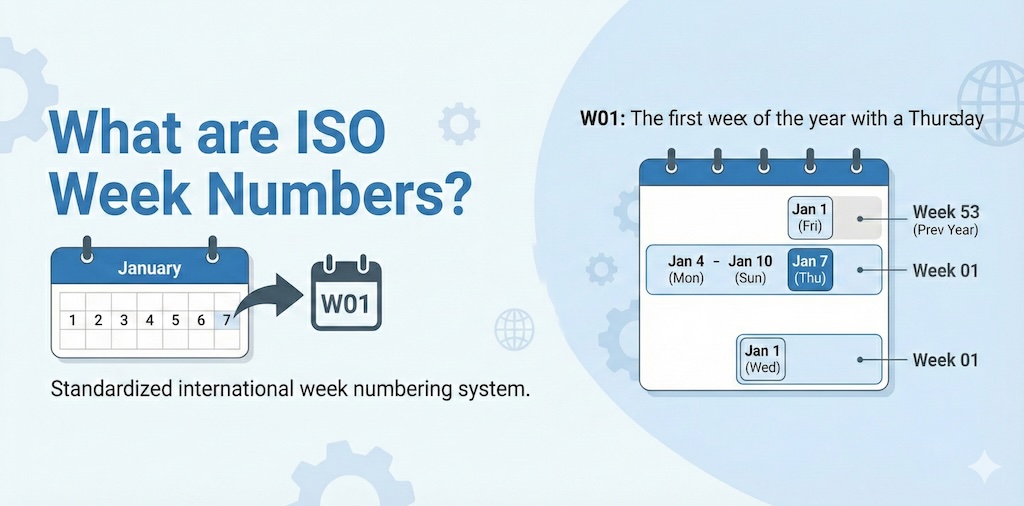
ISO week numbers come from the ISO 8601 date standard. Instead of month/day, it labels weeks as Week 01 through Week 52 (and sometimes Week 53).
Key ISO Week Rules (Plain English)
- Weeks start on Monday (not Sunday).
- Week 01 is the week that contains the year’s first Thursday (or equivalently, January 4).
- Because of this, the first few days of January can belong to the last ISO week of the previous year, and late December can fall into Week 01 of the next year.
This is why a date like January 1 might show up as “Week 52/53” of the previous ISO year in some systems. It’s not wrong—it’s just ISO being ISO.
A DOY tool pairs well with ISO week numbers because DOY answers “how deep into the year is this date?” while ISO weeks answer “which business week does this date belong to?”
Practical Uses of a Day of the Year Tool
DOY looks like trivia until you realize it’s a shortcut for a lot of everyday tasks—especially when you need a consistent “day index” that’s easy to sort, chart, or compare across dates.
- Year progress tracking: See how much of the year has passed and how many days remain (helpful for goals, deadlines, and planning).
- Fitness & habits: “Day 150 of the year” feels oddly motivating—like you’re in a long-running season of a show you actually like.
- Project planning: Convert milestones into day numbers for cleaner spreadsheets and trend lines.
- Weather and seasonal analysis: Compare temperatures or rainfall by day-of-year (DOY normalizes across years).
- Data science & reporting: Use DOY as a feature in time-series modeling or for bucketing seasonal behavior.
- Travel planning: Quickly estimate where a trip falls in the year’s timeline and compare costs or demand patterns.
- Education: Teach calendar math, leap years, and time concepts without causing anyone to cry (no promises).
Funny (and Surprisingly Useful) Calendar Facts
- Day 256 is celebrated as “Programmer’s Day” because 256 is 28—a classic computing number. It’s the 256th day of the year (and shifts by one in leap years).
- Your birthday’s DOY is like your date’s “jersey number.” Same day? Same jersey. Different year? Same vibe, maybe different jersey if leap years get involved.
- If you ever feel behind, check the year-progress percentage: it’s a friendly reminder that time is both real and unstoppable (but hey, at least you found a tool).
- ISO week numbers are the reason some people say “It’s Week 01” while everyone else is still emotionally in last year.
FAQ
Is Day of the Year the same as ISO week?
No. DOY counts the day within the year (1–365/366). ISO week numbers count the week (01–52/53) based on ISO 8601 rules. They answer different questions and are often used together in planning and reporting.
Does Day of the Year change in leap years?
Yes. In leap years, dates after February 28 have a DOY that is 1 higher than in a normal year because February has 29 days.
What’s the fastest way to calculate DOY manually?
Add up the days in prior months + day of month, then add +1 if it’s a leap year and the date is March 1 or later. Or… use the tool and save your brain for something more fun.
Tip: If your tool also shows the percent of year complete, it’s basically a “calendar progress bar” for life—use it for planning, motivation, and the occasional dramatic sigh.
Images generated by Google Gemini.
Related Tools
Leap Year Calculator
Find out if any year is a leap year.
Find a day
Convert dates to and from common calendar milestones.
Date Calculator
Date Calculator will calculate duration between dates, or add/subtract days.
Gregorian to Lunar Date Calculator
Convert a Gregorian calendar date to the Lunar (Chinese) calendar date.

Day of the Week
find the day of the week for any date—past, present, or future.

What is my Zodiac Sign
Enter your birth date to find your zodiac sign.
Suggest an improvement
Tell us if something is confusing, broken, incorrect, or missing. Feedback helps us improve the tools and workflows people use every day.